
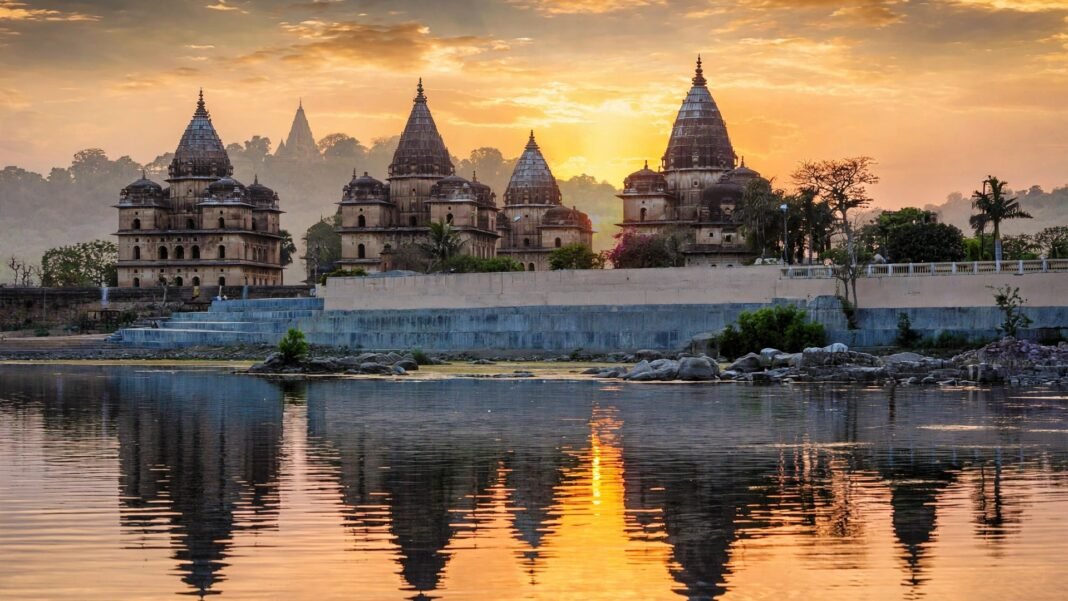
An Orchha one day itinerary is one of the most satisfying day trips in central India: a compact riverside town where 16th-century Bundela palaces, temples, and royal cenotaphs cluster within walking distance of each other, all set against the Betwa River. Orchha is just 16 km from Jhansi (30 minutes by auto), which makes it an easy day trip — but the town rewards a full day, from the fort complex in the morning cool to the cenotaphs glowing at sunset and the evening aarti at the Ram Raja Temple. This guide gives you an hour-by-hour plan, entry fees, food stops, and the practical details for 2026.
Reaching Orchha and When to Go
Orchha’s nearest railhead is Jhansi Junction, one of central India’s best-connected stations with trains from Delhi (4–6 hours), Bhopal, Agra, and Khajuraho. From Jhansi station, Orchha is 16 km — a 30-minute auto-rickshaw ride (₹200–₹300) or a pre-booked taxi; shared autos run cheaper. If you are driving, Orchha sits on the Jhansi–Khajuraho highway, about 230 km from Gwalior and 170 km from Khajuraho. The best time to visit Orchha is October to March, when the stone monuments are explorable without the brutal Bundelkhand summer (April–June crosses 40°C). Monsoon (July–September) greens the riverside and fills the Betwa, making the cenotaphs especially photogenic, though afternoon showers can interrupt plans.
Start the day by 8:30–9 AM: the fort complex opens at 9 AM, and the morning light on Jahangir Mahal’s sandstone is worth the early start.
Orchha One Day Itinerary: Morning — The Fort Complex
Begin at the Orchha Fort complex (open 9 AM–6 PM; entry roughly ₹10 for Indians and ₹250 for foreigners — verify current ASI rates at the gate). Inside the walled precinct stand the town’s two great palaces. Raja Mahal, the older of the two, is famous for its vivid interior murals — walls and ceilings painted with scenes from Hindu epics that have survived four centuries. Jahangir Mahal, built to honour the Mughal emperor’s visit, is the architectural showpiece: a stunning fusion of Rajput and Mughal styles with delicate jharokhas, hanging balconies, and eight grand domes.
Climb to its upper terraces for the classic Orchha panorama — the Betwa River, the chhatris, and the temple spires in one frame.
Allow 2–2.5 hours for the complex, and hire the ASI guide at the entrance (roughly ₹300–₹500 for a group) — the stories of the Bundela kings transform the stones from pretty to fascinating. Wear shoes with good grip: the fort’s stone stairs are steep and worn smooth. Do not miss the small Rai Praveen Mahal within the complex — a two-storey palace built for the poet-musician Rai Praveen, set around a garden with fine views. Photography lovers should note the fort is at its best in the first two hours after opening: soft light, few visitors, and the sandstone glows amber rather than bleaching white as it does at noon.
Midday — Temples and Lunch
From the fort, walk to the Chaturbhuj Temple, Orchha’s most imposing shrine — a massive, fortress-like structure dedicated to Vishnu, whose steep interior climb rewards you with sweeping views over the town. Then visit the Lakshmi Narayan Temple, quieter and celebrated for its exquisite frescoes and unusual Shri Yantra-inspired layout. By 12:30–1 PM, break for lunch: the dhabas and small restaurants near the fort serve Bundelkhandi staples — poori with spicy aloo sabzi, the refreshing spiced buttermilk called sannata, and full Bundelkhandi thalis. A filling lunch costs ₹150–₹250.
Use the hot early-afternoon hours (2–4 PM) for a rest or a slow walk along the Betwa riverside — the stone monuments hold the day’s heat, and you will enjoy them far more after the sun softens. If you want one more sight, Phool Bagh, the 18th-century garden complex with its fountains and pavilions, is a shaded, peaceful filler.
Evening — Cenotaphs at Sunset and Ram Raja Aarti
The day’s climax belongs to the royal chhatris (cenotaphs) on the banks of the Betwa. Fourteen memorials to Bundela rulers rise in a solemn row, and at sunset the sandstone turns molten gold against the river — it is the most photographed sight in Orchha and completely free to admire from the riverside. Walk among the chhatris as the light changes, then cross to the Betwa bridge or ghats for the wide view back across the water. As dusk settles, head to the Ram Raja Temple for the evening aarti (around 7–8 PM; timings shift seasonally — confirm locally).
This is no ordinary temple: it is the only shrine in India where Lord Ram is worshipped as a king, complete with a royal court, guards, and gun salutes on festival days. The aarti, with its drums, lamps, and chanting, is a powerful end to the day even for non-religious visitors. If you are staying the night, the Sound and Light Show at the fort narrates Orchha’s history after dark — check current show timings at the ticket counter.
Budget, Food and Shopping
A day trip from Jhansi is wonderfully cheap: transport ₹400–₹600 (auto round trip), fort entry ₹10–₹250, guide ₹300–₹500 split in a group, lunch ₹150–₹250, and evening snacks ₹100–₹200. Total: roughly ₹1,000–₹2,000 per person, or under ₹1,000 if you skip the guide and share transport. If you stay overnight, guesthouses and heritage hotels in Orchha range ₹1,000–₹4,000 per night, and the town is genuinely magical after the day-trippers leave. For food beyond lunch, try the sweets — jalebi and malpua from the old-town shops — and end the day with chai by the river. Shopping is small-scale but charming: handmade durries and carpets, wooden handicrafts, stone artefacts, and religious souvenirs near the Ram Raja Temple.
Bargain gently; these are artisan prices, not tourist-trap markups.
Practical Tips
Dress modestly — Orchha is a significant religious town, and covering shoulders and knees is expected inside the Ram Raja and Chaturbhuj temples (there is no strict dress code at the fort, but respectful clothing is appreciated everywhere). Carry cash; ATMs are limited and small shops do not take cards. The town is compact and walkable — you can cover the fort, temples, and riverside on foot, with autos only needed for the chhatris if you want to save your legs. Photography is restricted inside parts of the temples; follow the signs.
Adventure seekers can add a Betwa river rafting run — the stretch near Orchha has gentle grade I–II rapids suitable for beginners, typically run in the October–March season by local operators for roughly ₹500–₹1,000 per person. Book through your hotel a day ahead, and skip it during monsoon when the river runs too high. If you are combining destinations, Orchha pairs perfectly with Khajuraho (170 km, 3–4 hours) or a Jhansi Fort visit — many travellers do Jhansi Fort in the morning and Orchha from afternoon to evening, though that compresses the fort complex. One full day in Orchha, done right, beats two rushed ones.
More heritage journeys: our hidden places in Udaipur guide explores Rajasthan’s quieter royal heritage, and how to reach Hampi from Bangalore covers India’s greatest ruined capital. Official information: Madhya Pradesh Tourism and Incredible India.
Sources: Madhya Pradesh Tourism, ASI monument information, verified 2026 Orchha travel guides.
Frequently Asked Questions
How do I reach Orchha?
Orchha is 16 km from Jhansi Junction — a 30-minute auto ride (₹200-₹300) or shared auto. Jhansi has trains from Delhi (4-6 hours), Bhopal, Agra, and Khajuraho. By road, Orchha is on the Jhansi-Khajuraho highway.
What is the best one-day plan for Orchha?
Start at the fort complex at 9 AM (Raja Mahal, Jahangir Mahal), temples and lunch midday, rest 2-4 PM, the royal chhatris by the Betwa at sunset, and the Ram Raja Temple evening aarti around 7-8 PM.
What are the entry fees in Orchha?
The fort complex charges roughly ₹10 for Indians and ₹250 for foreigners (verify current ASI rates). The temples, riverside, and cenotaph views are free. A full day trip from Jhansi costs roughly ₹1,000-₹2,000 per person.
What is the best time to visit Orchha?
October to March, when the weather is pleasant for exploring stone monuments. April-June is brutally hot; monsoon (July-September) makes the Betwa riverside lush and photogenic but brings afternoon showers.