
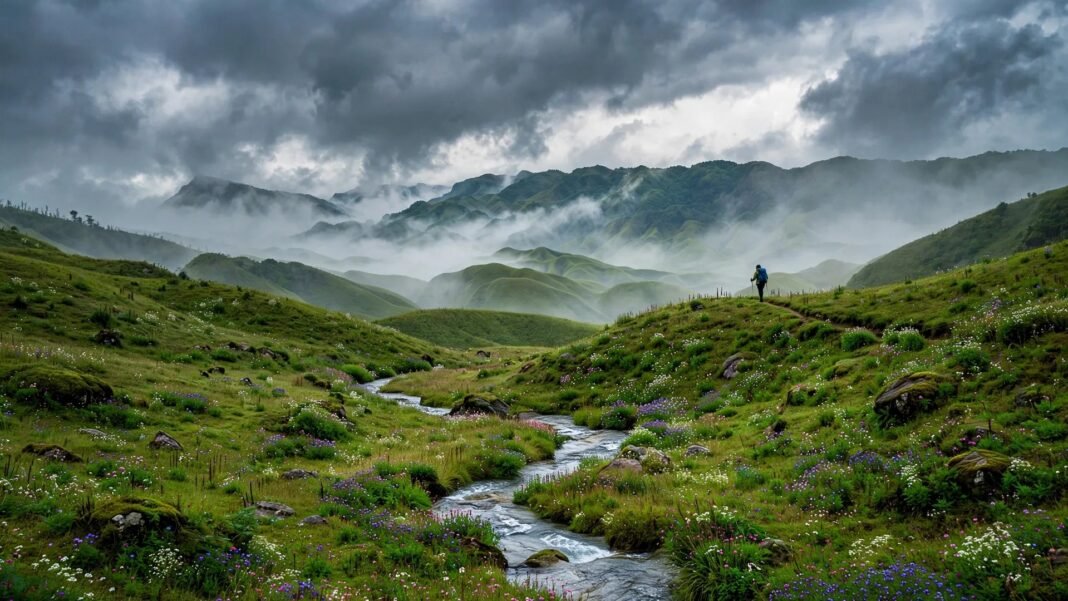
Is the Dzukou Valley trek difficulty beginners should expect manageable? Yes — with one honest caveat: the first hour is steep enough to make you question the “easy” label, but after that the trail levels into one of the most rewarding walks in India. Dzukou Valley, on the Nagaland–Manipur border at about 2,452 metres, is often called the Valley of Flowers of the Northeast — rolling green meadows, the winding Dzukou River, and in season, the rare Dzukou lily. The standard trek is 2 days and 1 night, costs just ₹2,000–₹4,000 per person, and needs no technical skill.
This guide breaks down the difficulty honestly, the costs line by line, and the first-timer tips that make the difference between a great trek and a miserable one.
Dzukou Valley Trek Difficulty Beginners Face: An Honest Breakdown
The trek is graded easy-to-moderate, and that is accurate for anyone with basic fitness — think: you can walk 8–10 km in a day and climb stairs without distress. The most popular route starts at Viswema village: roughly 8 km one way to the valley, taking 3–4 hours for average fitness (2–2.5 for the fit). The first 45–60 minutes are the crux — a steep, root-laced climb through dense forest that gains most of the trek’s ~900 metres of elevation. Then you crest the ridge, and the character changes completely: a gentle, almost flat walk across the valley floor to the trekkers’ hut and campsite.
The alternative Jakhama route is shorter but steeper throughout; Viswema is longer but kinder, and it is the right choice for beginners. There is no scrambling, no exposure, no river crossing, and no altitude risk to speak of at 2,452 m — the challenge is purely cardiovascular. If you have never trekked before, spend 2–3 weeks before the trip walking 5–8 km a few times a week with a loaded backpack; that single preparation step converts this trek from “tough” to “thoroughly enjoyable.” People over 60 and kids above 10 do this trek regularly — fitness matters more than age.
Cost Breakdown: One of India’s Cheapest Great Treks
A 2-day, 1-night Dzukou trek costs roughly ₹2,000–₹4,000 per person for everything trek-related — remarkably cheap next to Himalayan treks where operator packages run ₹8,000–₹15,000. The pieces: Inner Line Permit (ILP) for Nagaland, mandatory for Indian citizens — ₹50 online via the Nagaland ILP portal, ₹100 offline; apply a few days ahead. Valley entry fee at the trailhead checkpost: ₹50–₹100 per person (carry a valid photo ID). Guide: ₹800–₹2,500 per day — optional on the well-marked Viswema trail but highly recommended for first-timers and solo trekkers; split among a group it is trivial per person. Porter: ₹700–₹2,000 per day if you want your bag carried.
Stay: the trekkers’ hut dorm at the valley costs ₹100–₹200 per person (basic hall, floor sleeping — bring or rent a sleeping bag); pitching your own tent costs ₹200–₹300; pre-pitched tents run ₹1,000–₹1,500. Food: simple dal-rice meals at the hut, slightly pricey because everything is carried up — budget ₹400–₹600 for the trek. Transport: Dimapur to Kohima by shared Sumo ₹400–₹600 per seat (3–4 hours); Kohima to Viswema/Jakhama by shared taxi ₹150–₹250; a private taxi to the trailhead costs ₹2,000–₹3,000. Base homestays in Kigwema or Viswema: ₹1,200–₹2,500 per night. Add your travel to Dimapur (flights from Delhi/Kolkata ₹4,000–₹8,000 return if booked early; trains to Dimapur are the budget option).
Verify permit rules before you go — Manipur-side entries have separate requirements.
How to Reach the Trek Start
Fly into Dimapur (Nagaland’s only airport with commercial flights) or take a train to Dimapur railway station. From Dimapur, shared Sumo taxis to Kohima (74 km, 3–4 hours) leave through the morning from the main taxi stand — ₹400–₹600 per seat. Kohima is the base town: spend a night here to arrange permits, withdraw cash, and buy any last supplies. From Kohima, shared taxis to Viswema or Jakhama (20–25 km) cost ₹150–₹250 per seat, or hire a private taxi (₹2,000–₹3,000) to reach the actual trailhead and save 2–3 km of road walking.
Most trekkers stay the night before in Kigwema or Viswema homestays — your host is effectively your tour operator and will arrange the guide, transport, and packed lunch better than any agency. Start the trek by 7 AM: you want to reach the valley by late morning, giving you the whole afternoon to explore the lily fields, the helipad viewpoint (15 minutes from the dorm, superb at sunset), and the valley floor trails.
Sample 2-Day Dzukou Itinerary
Day 1: Leave Kohima by 6 AM and reach the Viswema trailhead by 7–7:30 AM. Climb through the forest section (the steepest hour), crest the ridge by 9:30–10 AM, and walk the valley floor to the trekkers’ hut by 11 AM–12 noon. After lunch and rest, spend the afternoon exploring: the lily fields (in season), the Dzukou River streams, and the helipad viewpoint for sunset. Dinner at the hut, then stargazing — the Milky Way is routinely visible on clear nights. Day 2: Wake for sunrise on the valley rim, have breakfast, pack up, and begin the descent by 8–9 AM.
You will be back at Viswema by noon and in Kohima for a late lunch. Fit trekkers sometimes do it as a long day trip (7:30 AM to 6 PM), but you miss the sunset, the stars, and the morning mist — the three best things about Dzukou. If you have a third day, spend it in Kohima: the War Cemetery, the Naga Heritage Village at Kisama (especially atmospheric around the Hornbill Festival in early December), and the local markets are worth half a day.
Best Time to Go and First-Timer Tips
The best time for Dzukou is October to May. October–November gives clear skies and green-gold meadows — the classic postcard season. December–February is cold (nights near freezing, possible frost) but crowd-free and starkly beautiful. March–May is pleasant and uncrowded. June–September is lily season — the valley blooms with the endemic Dzukou lily — but it also brings heavy rain, leeches, and slippery trails; go only if flowers are your priority, with rain gear and salt for leeches. First-timer tips that matter: there is no mobile network in the valley, so download offline maps and inform someone of your plan. Carry all your cash from Kohima — nothing beyond takes cards or UPI reliably.
Pack warm layers even in summer; the valley is windy and nights are cold year-round.
Carry 2 litres of water and snacks — the hut food is basic and you will want energy on the trail. Packing checklist: broken-in trekking shoes with ankle support, a 30–40 litre backpack, warm layers (fleece + windproof jacket), a sleeping bag or liner for the dorm, a headlamp, 2 litres of water capacity, high-energy snacks, sunscreen, a basic first-aid kit, and a power bank — there is no electricity in the valley. Take every wrapper back down with you; Dzukou’s beauty survives because trekkers keep it clean.
And stay the night if you can: the sunset from the helipad, the star density with zero light pollution, and the morning mist over the meadows are the three things day-trekkers miss — and they are the soul of Dzukou.
More beginner-friendly mountains: our Kasol Kheerganga trek budget guide covers the Himalaya’s classic first trek, and how to reach Spiti Valley from Delhi plans the next level up. Official information: Nagaland Tourism and Incredible India.
Sources: Nagaland Tourism, Nagaland ILP portal information, verified 2026 Dzukou Valley trek guides.
Frequently Asked Questions
How long is the Dzukou Valley trek?
The Viswema route is about 8 km one way, taking 3-4 hours for average fitness. The Jakhama route is shorter but steeper. With valley exploration, the total is roughly 16-20 km over two days.
What is the cost of the Dzukou Valley trek?
Roughly ₹2,000-₹4,000 per person for a 2-day, 1-night trek: ILP (₹50 online), entry fee (₹50-100), guide (₹800-2,500/day, split in groups), hut stay (₹100-200), food, and local transport. Travel to Dimapur/Kohima is extra.
Do I need a permit for the Dzukou Valley trek?
Yes — Indian citizens need an Inner Line Permit for Nagaland (₹50 online via the Nagaland ILP portal, ₹100 offline). Carry it plus a valid photo ID; there is also a small entry fee at the trailhead checkpost.
What is the best time to trek Dzukou Valley?
October to May. October-November has the clearest skies; December-February is cold but crowd-free; June-September brings the famous Dzukou lilies but also heavy rain, leeches, and slippery trails.