
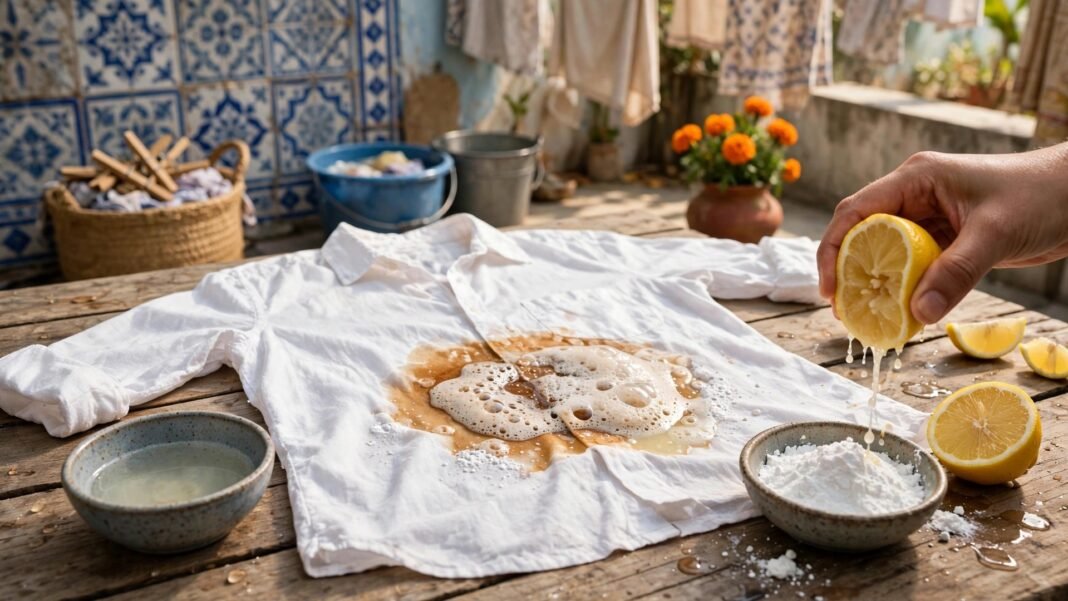
Tea stains on white clothes are a special kind of heartbreak — the brown ring on a white kurta, the splatter on a school uniform, the drip on a white office shirt that everyone can see from across the room. This guide to remove tea stains white clothes with home remedies is deliberately narrow: white and light-coloured clothes only. That focus matters, because white fabric lets you use stronger kitchen remedies – lemon, vinegar, baking soda, and sunlight – without worrying about colour fading, which is the main constraint in general stain guides. Everything here uses ingredients already in an Indian kitchen, costs almost nothing, and works on chai, green tea, and milk-tea stains alike.
Why Tea Stains White Clothes So Stubbornly
Tea’s brown colour comes from tannins — the same plant compounds that make tea astringent on your tongue. Tannins bind readily to cotton and other natural fibres, and the bond strengthens with heat and time. That is why a chai splash rinsed immediately often vanishes with plain water, while the same splash discovered after a full day — or worse, after the garment went through a hot wash — becomes a permanent-looking brown shadow that needs real chemistry to remove.
Milk-tea (chai) stains add a second component: milk proteins that coagulate with heat, effectively gluing the tannin to the fabric. So the golden rule for white clothes: treat tea stains with cool or lukewarm water first, never hot, until the tannin is out. The home remedies below are ordered from gentlest to strongest; start at the top and move down only if the stain persists. Because these garments are white, you can also finish every method with direct sunlight – UV bleaches residual tannin naturally, with zero chemicals.
Kitchen Remedy 1: White Vinegar Soak
White vinegar (safed sirka, Rs. 40–60 a bottle) is the best all-round remedy to remove tea stains white clothes. The mild acetic acid loosens tannin’s grip on cotton fibres without damaging the fabric. Method: mix one part white vinegar with two parts cool water in a basin, submerge the stained area, and soak for 30 minutes. For a fresh stain, you will often see the brown colour bleeding into the water within minutes.
After soaking, rub the stain gently between your fingers or with a soft brush, then wash normally with detergent. For an older stain, extend the soak to 2 hours, refreshing the solution once. Vinegar is safe for white cotton, linen, polyester, and most white synthetics; avoid it on white silk and wool, which prefer gentler handling. The vinegar smell rinses out completely in the wash – if any odour lingers, a second rinse with a spoon of baking soda in the water removes it.
Kitchen Remedy 2: Baking Soda Paste
Baking soda (khane wala soda, Rs. 20–30 a packet) works on tea stains through gentle alkalinity and mild abrasion – it lifts tannin mechanically as you work the paste into the weave. Method: make a thick paste with 2 tablespoons of baking soda and just enough cool water to bind it. Spread it generously over the dampened stain, working it in with your fingers or a soft toothbrush in small circles. Leave the paste on for 30–45 minutes, then rinse thoroughly and wash normally.
This method shines on dried tea rings — the brown circle left by a cup base — because the paste sits exactly where the concentrated tannin is. For a large stained area, add half a cup of baking soda directly to the washing machine drum along with your regular detergent; it boosts the detergent’s cleaning power on all whites, not just the stained garment. One caution: rinse baking soda out fully, because dried residue can leave white streaks on dark trims or buttons – not a problem on all-white garments, but worth knowing.
Kitchen Remedy 3: Lemon Juice and Sunlight
Lemon is the traditional Indian whitening agent, and on white clothes it is genuinely effective against tea tannin. The citric acid breaks down the stain while sunlight’s UV rays bleach whatever remains – the combination is stronger than either alone. Method: squeeze fresh lemon juice directly onto the stain (about half a lemon for a palm-sized mark), rub it in gently, sprinkle a pinch of salt over it for mild abrasion, and lay the garment flat in direct sunlight for 2–3 hours, keeping the stain damp with occasional sprinkles of water or more lemon juice.
Then wash normally. This is the method to reach for when vinegar and baking soda have lightened but not fully removed an old stain. It is strictly for whites and very light colours – lemon plus sun will fade dyed fabric, which is exactly why this guide stays in white-clothes territory. Bottled lemon juice works in a pinch, but fresh lemons contain more active acid and cost only a few rupees at any vegetable vendor in your neighbourhood market.
Tea Stains on White School Uniforms: A Daily Routine
White school uniforms suffer tea and milk stains almost daily in Indian homes, and parents need a routine, not a project. The practical system: keep a small basin or bucket in the laundry area with cool water and a spoon of salt. The moment a stained uniform comes home, it goes straight into the salt water – no waiting for wash day, because every hour the tannin bonds tighter.
In the evening, pull it out, apply the vinegar soak or baking soda paste to any visible marks to remove tea stains white clothes while making dinner, and toss it in the next morning’s wash. Once a week, wash all whites together with half a cup of baking soda added to the drum to keep the whole batch bright. This 5-minute-a-day habit prevents the slow accumulation of faint brown shadows that eventually make uniforms look permanently dingy. The same routine works for white office shirts and kurtas – the salt-water bucket does not care whose clothes they are.
Remove Tea Stains White Clothes: Old, Set, or Milk-Tea Stains
Old tea stains — discovered after washing, or on a garment stored stained for weeks — need the remedies layered. Start with the vinegar soak (2 hours), follow with the baking soda paste (45 minutes), and finish with lemon and sunlight. This sequence moves from acid to alkali to acid-plus-UV, attacking the tannin bond from three directions, and it clears most set stains that any single remedy leaves behind. For chai stains with milk, add one extra first step: soak in cool salted water (a tablespoon of salt per litre) for 30 minutes before anything else.
The salt water dissolves milk proteins without heat-coagulating them — skip this and go straight to warm water, and the protein sets around the tannin, making everything harder. If a white garment has both tea and haldi marks (common after Indian breakfasts), treat the turmeric first using our turmeric stain guide, because haldi’s rules (cold water, no heat) are stricter. For grease-based food stains, see how to remove oil stains, and for old food stains generally, how to remove dried curry stains.
Sources: tannin chemistry per standard food-chemistry references; home-remedy methods to remove tea stains white clothes are consistent with textile-care guidance from university extension laundry publications.
With these kitchen remedies, you can remove tea stains white clothes in under an hour — start with the gentlest method and let sunlight finish the job.
Frequently Asked Questions
How do you remove old tea stains from white shirts?
Layer the remedies: a 2-hour vinegar soak, then baking soda paste for 45 minutes, then lemon juice in direct sunlight. This clears most set stains.
Does lemon juice bleach white clothes?
Lemon juice with sunlight has a mild bleaching effect on whites, which is why it works on tea stains. Never use it on coloured clothes.
How do you remove chai (milk tea) stains?
Soak first in cool salted water for 30 minutes to dissolve milk proteins without heat-setting them, then treat the tannin stain normally.
Can baking soda whiten white clothes?
Yes. Adding half a cup to the wash drum boosts detergent and keeps whites bright, and as a paste it lifts tea rings through gentle abrasion.