
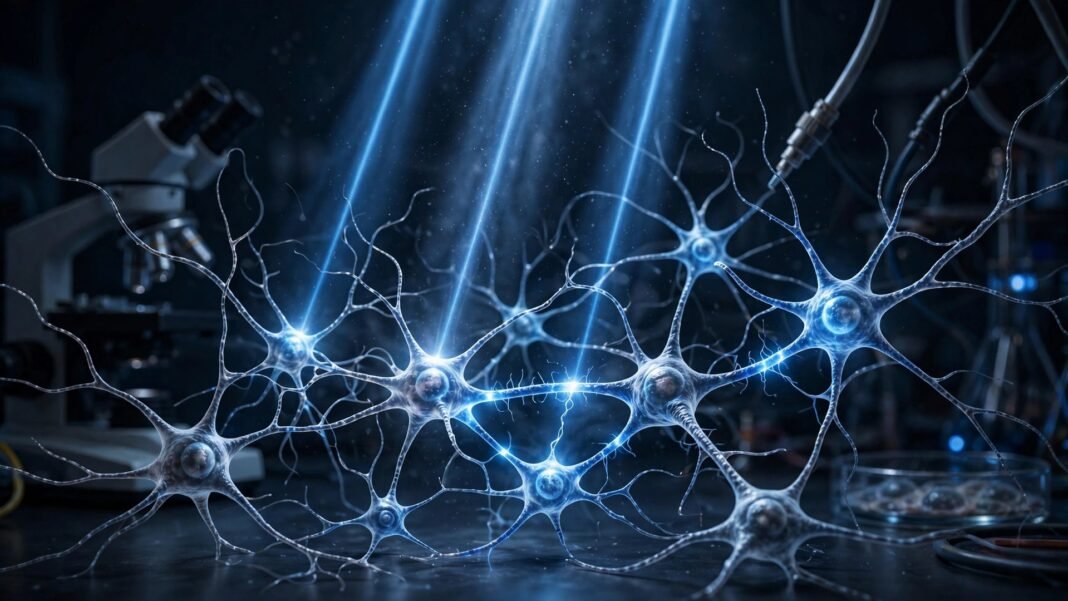
The 2026 Nobel week is underway. The Nobel Prize 2026 Medicine award has gone to American Karl Deisseroth and Germans Peter Hegemann and Georg Nagel for their pioneering work on optogenetics — a revolutionary technique that uses light to switch individual nerve cells on and off in the living brain.
Announced on October 5 by the Nobel Assembly at Sweden’s Karolinska Institutet, the prize carries 12 million Swedish kronor (about $1.2 million), shared among the three laureates.
Nobel Prize 2026 Medicine: The Winners
- Karl Deisseroth, 54 — American psychiatrist and bioengineer, Stanford University and Howard Hughes Medical Institute
- Peter Hegemann, 71 — German biochemist, Humboldt University, Berlin
- Georg Nagel, 73 — German biophysicist, University of Würzburg
What Is Optogenetics?
The story begins with pond algae. In the 1990s-2000s, Hegemann and Nagel discovered channelrhodopsin — a light-sensitive protein in the single-celled alga Chlamydomonas that opens an ion channel when struck by blue light. They had found the “light switch” neuroscientists had dreamed of.
Deisseroth then did the transformative experiment: in work published in 2005, he genetically engineered rat nerve cells to produce channelrhodopsin, proving their activity could be controlled with light. By 2007, he had demonstrated the technique in living mice brains.
Optogenetics “makes it possible to switch on, or off, the activity of individual nerve cells in a living brain,” the Nobel Assembly said — letting scientists map precisely how neural circuits create memories, emotions and behaviour. It is now used in labs worldwide to probe Parkinson’s disease, epilepsy, sleep disorders and depression, and to hunt new drug targets.
Why It Matters
“It’s a completely new dimension of understanding of the function of the brain,” said Nobel committee member Anna Wedell. The Nobel Prize 2026 Medicine honours not just a discovery but the birth of a field — one that turned a humble alga’s trick for swimming toward light into humanity’s most precise window into the mind.
Nobel Prize 2026 Physics: Francis Halzen
The 2026 Nobel Prize in Physics has been awarded to Belgian-American physicist Francis Halzen, 82, for “decisive contributions to the IceCube Neutrino Observatory and the discovery of high-energy neutrinos of astrophysical origin,” the Royal Swedish Academy of Sciences announced on October 6.
Halzen, a professor at the University of Wisconsin–Madison, first proposed in 1988 that Antarctic ice could serve as a giant neutrino detector. That vision became the IceCube Neutrino Observatory — thousands of light sensors buried two kilometres beneath the South Pole ice — built by an international collaboration of more than 450 researchers from 58 institutions in 14 countries. It has opened an entirely new type of astronomy, letting scientists trace “ghostly” cosmic neutrinos back to distant galaxies and exploding stars.
“Francis Halzen has led an international team of researchers and engineers who have provided us with a fantastic instrument. His tenacity and scientific vision has paved the way for a new kind of astronomy,” said Nobel committee chair Mark Pearce.
Nobel Prize 2026 Chemistry: Henri B. Kagan and Kenso Soai
The 2026 Nobel Prize in Chemistry has been awarded jointly to Henri B. Kagan, emeritus professor at Université Paris-Saclay, France, and Kenso Soai, professor emeritus at Tokyo University of Science, Japan, “for the discovery of non-linear effects and autocatalysis in asymmetric organic synthesis”. The Royal Swedish Academy of Sciences announced the prize on October 7, 2026.
Many molecules exist in two mirror-image forms, yet living organisms build themselves from only one — a mystery chemists call the problem of asymmetry. Kagan discovered non-linear effects in asymmetric catalysis in 1986; Soai then found asymmetric autocatalysis, where a chiral compound catalyses its own production and amplifies its own mirror-image form. The Academy said their work has been revolutionary for chemists developing reactions to manufacture pharmaceuticals, flavours, fragrances and new materials.
The medicine prize opened Nobel week on October 5, followed by the Physics prize on October 6 and the Chemistry prize on October 7 — with literature, peace and economics still to come.
Sources: Reuters, Britannica.
Nobel Prize 2026 Literature: Anne Carson
The 2026 Nobel Prize in Literature has been awarded to Anne Carson, the Canadian poet, essayist and translator, “for her bold and inventive oeuvre that, in playful dialogue with the classical tradition, has created new forms for contemporary literature”. The Swedish Academy announced the prize on October 8, 2026.
Carson’s work defies genres, blending poetry, prose, essay, translation and classical scholarship. Trained as a classicist, she has translated ancient Greek texts — including plays by Sophocles and Euripides — while creating original works such as the verse novel “Autobiography of Red” (1998). The Academy noted that her writing sits at the meeting point of a philologist’s fascination with words and a poet’s search for new meaning, with the etymology of words as the starting point for her work.
Nobel Prize 2026 Peace: Navanethem “Navi” Pillay
The 2026 Nobel Peace Prize has been awarded to Navanethem “Navi” Pillay, the South African jurist, “for her efforts to promote peace and international law”. The Norwegian Nobel Committee announced the prize on October 9, 2026.
Pillay, 85, was born into a family of Indian Tamil origin under apartheid in Durban and began her career defending anti-apartheid activists. She went on to serve as a judge on South Africa’s High Court, the International Criminal Tribunal for Rwanda and the International Criminal Court, and as United Nations High Commissioner for Human Rights from 2008 to 2014. The Committee noted her role in landmark rulings establishing that rape and sexual violence can constitute genocide and crimes against humanity.
Frequently Asked Questions
What is optogenetics?
A technique using light-sensitive proteins (channelrhodopsin) to switch individual nerve cells on or off in the living brain.
What is channelrhodopsin?
A light-gated ion channel protein discovered by Hegemann and Nagel in the alga Chlamydomonas; Deisseroth showed it could control nerve cells.
How much is the Nobel Prize money?
12 million Swedish kronor (about $1.2 million), shared among the three laureates.
When was the Nobel Medicine prize announced?
October 5, 2026, by the Nobel Assembly at Karolinska Institutet — it traditionally opens Nobel week.