
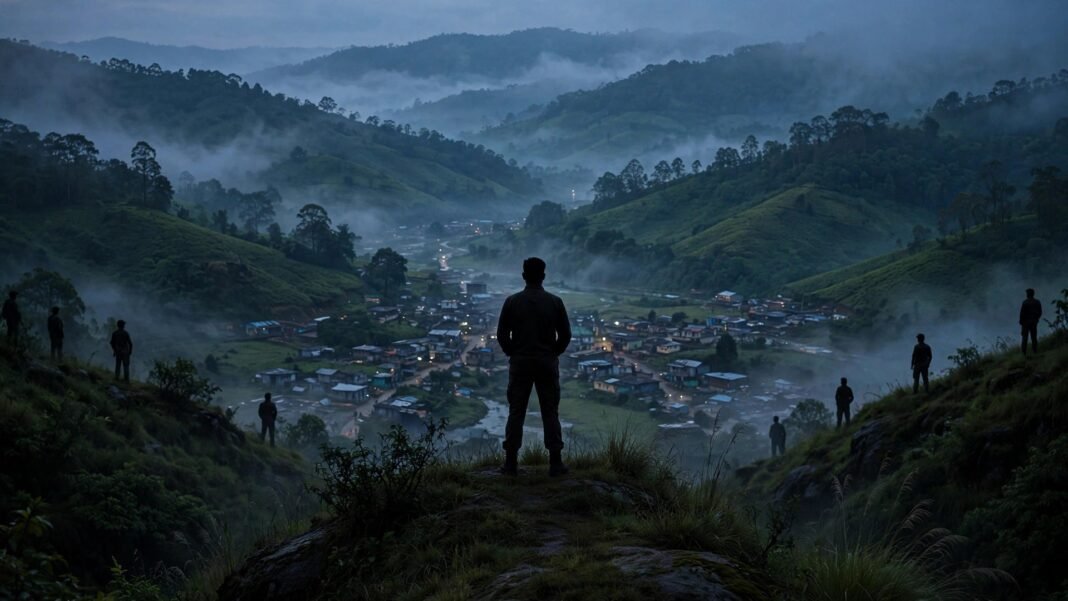
Related reading: Manipur violence is the focus of this guide. For wider policy context, see our explainers on the Caste Census in India, the One Nation One Election Bill and Ayushman Bharat. This Manipur violence guide covers Manipur violence causes, the Manipur violence timeline, Manipur violence status and Manipur violence relief efforts.
The Manipur violence, explained factually, is an ethnic conflict between the Meitei community of the Imphal valley and the Kuki-Zo tribal communities of the surrounding hills that erupted on 3 May 2023 and has since killed more than 250 people and displaced over 60,000. Rooted in competing demands over tribal status, land, and identity, it has involved arson, blockades, looted armouries, and prolonged internet shutdowns. This article lays out the background, the timeline, each side’s stated positions, and the current status, in neutral terms.
Manipur Violence Explained: Background and the Two Communities
Manipur’s geography shapes its politics. The Meiteis, about 53% of the state’s population and predominantly Hindu, live mainly in the Imphal valley, which is roughly 10% of the state’s land area. The Kuki-Zo and Naga tribal communities, predominantly Christian and recognised as Scheduled Tribes, inhabit the surrounding hill districts. The Meiteis are not on the Scheduled Tribe list; the hill tribes are, which gives the latter protections in land ownership, government jobs and education under the Constitution.
Tensions built over several issues. The Meitei community has long demanded Scheduled Tribe status, arguing it needs constitutional protection against demographic and economic pressures. In March 2023, the Manipur High Court directed the state government to consider the Meitei ST demand, a ruling the tribal communities saw as a threat to their rights and protections. Separately, the state government’s campaign against poppy cultivation and alleged illegal immigration from Myanmar heightened Kuki-Zo anxieties, while Meitei groups pointed to demographic changes in hill areas. Each community disputes the other’s narrative on these points.
Timeline: From 3 May 2023 Onward
- 3 May 2023: The All Tribal Students’ Union Manipur organises a “Tribal Solidarity March” in hill districts against the ST demand. Violence erupts in Churachandpur and spreads to the valley and other districts. Houses, churches, temples and vehicles are torched; curfew is imposed and the Army and Assam Rifles are deployed.
- May-June 2023: Clashes continue. Mobs loot police armouries, and thousands of weapons go missing, with over 6,000 arms reported looted. The state government suspends mobile internet, a shutdown that lasts for months. Tens of thousands flee to relief camps.
- July 2023: A video of two Kuki-Zo women being paraded naked surfaces, triggering national outrage and a Supreme Court-monitored response. The CBI takes over the case.
- 2023-2024: Sporadic killings, arson and blockades continue. National Highways 2 and 37, the valley’s lifelines, run through Kuki-Zo areas and remain effectively blocked for Meitei travellers. The Kuki-Zo side demands a separate administration; Meitei groups demand implementation of the National Register of Citizens and deportation of those they describe as illegal immigrants, along with abrogation of the Suspension of Operations (SoO) pact with Kuki-Zo insurgent groups.
- October 2024: An MHA-convened meeting of Meitei and Kuki-Zo MLAs in Delhi fails to bring the two sides into one room.
- April 2025: Representatives of Meitei and Kuki-Zo civil society groups hold their first joint peace talks, described by officials as a significant step.
- 9 February 2025: Chief Minister N. Biren Singh resigns. President’s Rule is imposed on 13 February 2025, with the assembly kept in suspended animation.
- August 2025: President’s Rule is extended for six months from 13 August 2025. On 4 September 2025, the SoO pact with Kuki-Zo groups is renewed with new terms.
- 13 September 2025: Prime Minister Narendra Modi visits Manipur for the first time since the violence began.
- Early 2026: President’s Rule is revoked around February 2026. Fresh Naga-Kuki tensions erupt: from 7 February 2026, clashes in Ukhrul, Kangpokpi and Kamjong districts kill more than 40 people.
- September 2026: The one-year SoO pact extension expires on 4 September; as of early October 2026, the Home Ministry is yet to announce an extension.
The Competing Demands, Stated Neutrally
The Kuki-Zo leadership’s stated position is that coexistence under the existing state arrangement is no longer possible after the violence, and they demand a separate administration for Kuki-Zo areas. They cite the killings, displacement and what they describe as a partisan state machinery. The Meitei leadership’s stated position is that the state’s territorial integrity must be protected, that illegal immigration must be checked through measures such as the NRC, and that the SoO agreement with Kuki-Zo armed groups should be abrogated, alleging violations of its ground rules. The Naga community, the third major group, has its own distinct positions and has at times clashed with Kukis, as the 2026 Ukhrul violence showed. The central government’s stated approach has been security deployment, dialogue through an interlocutor, and confidence-building measures such as the push for free movement on highways.
Human Cost and Current Status
By most counts, the Meitei-Kuki clashes of 2023-2025 killed over 250 people, injured more than 1,500, and displaced over 60,000, many of whom remain in relief camps years later. The looted weapons have still not been fully recovered. As of October 2026, the state has an elected government again after President’s Rule was lifted, but peace remains fragile: the SoO pact’s renewal is pending, the separate-administration demand is unresolved, thousands remain displaced, and the new Naga-Kuki front has added another layer of instability. For readers following the story, the key indicators to watch are the SoO decision, progress on resettling displaced families, and whether dialogue between the communities continues.
Relief Camps and the Long Road to Normalcy
Behind the political timeline lies a humanitarian crisis that has received less attention than it deserves. At the peak of the violence, tens of thousands of people, Meitei families from hill-adjacent areas and Kuki-Zo families from the valley, fled homes their families had occupied for generations. Many remain in relief camps years later, living in school buildings, community halls and prefabricated shelters with limited privacy, schooling for children, and livelihoods. Farmers from both communities have been unable to cultivate fields located across the ethnic divide, and traders have lost businesses burned in the initial arson.
The geography of fear is now entrenched: buffer zones patrolled by central forces separate valley and hill areas, and members of each community avoid the other’s territory. Rebuilding trust will require more than the absence of shooting. Resettlement of displaced families to their original homes, recovery of looted weapons, credible investigations into the worst atrocities, and economic rehabilitation are all pending. The central government’s free-movement directive for highways, issued in March 2025, was meant as a normalcy signal but met resistance, showing how far the ground reality is from administrative orders. For ordinary Manipuris, the conflict’s end will be measured not in pacts and press releases but in whether children can go back to their old schools and farmers to their old fields.
The SoO Pact: A Key Piece of the Puzzle
Understanding the Suspension of Operations agreement helps decode much of the rhetoric around Manipur. Signed in 2008 between the Centre, the Manipur government and two Kuki-Zo umbrella groups representing 24 insurgent outfits, the tripartite pact brought these groups into designated camps under ground rules that barred fresh violence. It has been extended periodically ever since. Meitei organisations and the former state government alleged that some SoO groups violated the ground rules and fuelled the 2023 violence, demanding the pact’s abrogation; Kuki-Zo groups deny this and call the pact essential for the peace process.
The pact was renewed with new terms on 4 September 2025 while the state was under President’s Rule, days before the Prime Minister’s visit. Its one-year term expired on 4 September 2026, and as of October 2026 the Home Ministry had not announced an extension, though officials have indicated that a lapsed extension is not the same as abrogation. Whether and on what terms it is renewed will be one of the clearest signals of the Centre’s strategy for the hills.
Sources: The Hindu: SoO pact with Kuki-Zo groups; Times of India: President’s Rule extended in Manipur.
Frequently Asked Questions
What caused the Manipur violence?
The immediate trigger was opposition to the Meitei demand for Scheduled Tribe status, amid longer-running tensions over land rights, poppy cultivation and alleged illegal immigration.
Who are the Meiteis and Kukis?
The Meiteis, about 53% of Manipur's population, live mainly in the Imphal valley; the Kuki-Zo tribes, recognised as Scheduled Tribes, inhabit the surrounding hills.
How many people were affected by the Manipur violence?
Over 250 people were killed, more than 1,500 injured, and over 60,000 displaced, many of whom remain in relief camps.
What is the current status of Manipur?
President's Rule imposed in February 2025 was revoked in early 2026; joint peace talks have begun, but displacement continues and the SoO pact's renewal was still pending as of October 2026.