Learning how to become pilot after 12th India is exciting — and expensive enough that you must go in with your eyes open. This is the honest 2026 guide: the exact eligibility, the DGCA medical and exam process, the real CPL cost (₹45 lakh to well over ₹1 crore depending on your route), and the hard truths about medical failures, loans, and airline hiring that flying schools rarely mention.
Eligibility: The Non-Negotiable Basics
The Directorate General of Civil Aviation (DGCA) sets clear entry rules for a Commercial Pilot Licence (CPL). You must have passed Class 12 with Physics and Mathematics — there is no official percentage bar for starting training, though individual flying schools may set their own. Did not take science in school? You can complete Physics and Maths through NIOS (National Institute of Open Schooling) on-demand exams and become eligible. Minimum age is 17 to begin training (18 at licence issue), and you need functional English communication skills since all aviation communication is in English.
The Medical: Get This Done FIRST
Before spending a single rupee on ground classes, get your DGCA Class 2 medical from a DGCA-approved medical examiner. This screens vision (6/6 correctable in most cases, with limits on colour blindness), hearing, ECG, blood work, and general physical fitness. Later in training you will need the stricter Class 1 medical. Here is the brutal honesty: a meaningful number of aspirants discover disqualifying conditions — colour vision deficiency, for instance — only after enrolling. The medical costs roughly ₹10,000–25,000 including renewals through training. Do it before you commit lakhs. If you clear Class 1 comfortably, you have removed the single biggest career-ending risk.
How to Become Pilot After 12th India: The Step-by-Step Path
- Step 1 — Class 12 with Physics & Maths (or NIOS equivalent).
- Step 2 — DGCA Class 2 medical, then Class 1 during training.
- Step 3 — DGCA ground classes and theory exams: Air Navigation, Aviation Meteorology, Air Regulations, Technical General/Specific, plus RTR (Aero) radio telephony. Ground school coaching costs roughly ₹1.5–4 lakh; DGCA exam fees run ₹20,000–50,000 across subjects. Clearing papers on the first attempt saves serious money and months.
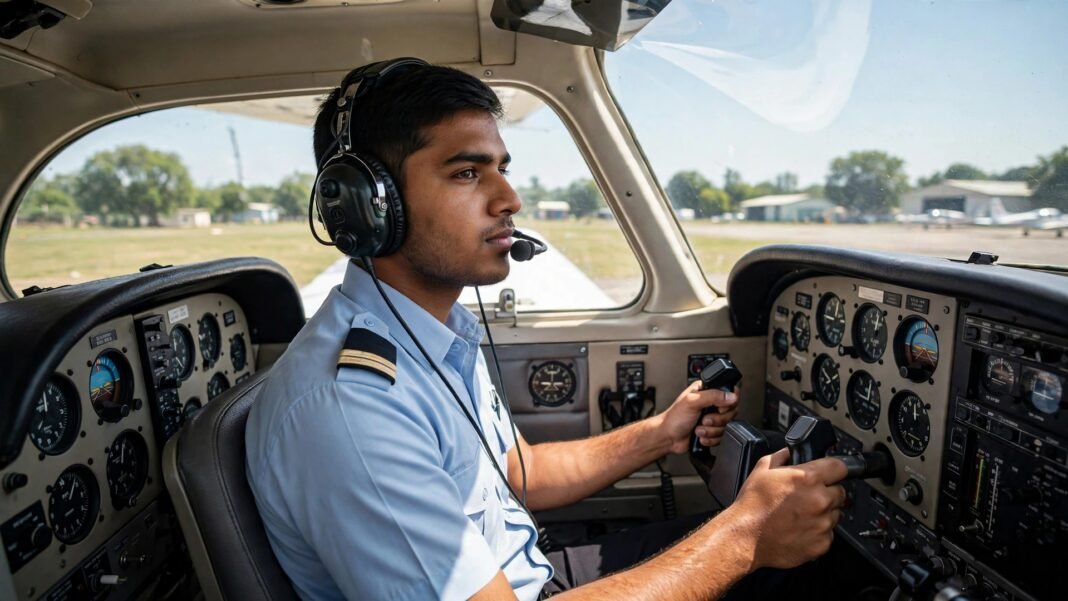
- Step 4 — Flying training: a minimum of 200 hours including solo, cross-country, instrument and night flying, plus multi-engine endorsement. This is the dominant cost — roughly ₹35–55 lakh at Indian flying schools, at ₹14,000–35,000 per flying hour depending on aircraft.
- Step 5 — CPL issue after skill tests with DGCA examiners.
- Step 6 — Type rating (A320 or B737, ~₹15–35 lakh), which most airlines effectively expect before induction.
CPL Cost in India 2026: Real Numbers by Route
Total investment varies enormously by route. The government-run IGRUA (Rae Bareli) charges a total programme fee of ₹45 lakh for its 24-month CPL course — the cheapest credible option, but admission is fiercely competitive. Tier-B private academies run ₹45–55 lakh; major private academies with modern glass-cockpit fleets charge ₹55–65 lakh+; and airline cadet programmes (IndiGo, Air India routes) cost ₹85 lakh–1.2 crore all-in. Add living expenses (₹3–8 lakh over 18–24 months), equipment, and a contingency buffer for extra hours and re-exams, and a realistic all-in budget for the independent CPL route is ₹55–80 lakh. Financing this big a sum?
Read our guide to scholarships for students in India 2026 — and note honestly that dedicated CPL scholarships are rare, so most families use education loans against collateral.
The Honest Downsides Nobody Advertises
Three risks deserve equal billing with the dream. First, training loans of ₹50–80 lakh mean EMIs starting around ₹60,000–80,000/month — if airline hiring slows (it is cyclical), you service that debt without a pilot salary. Second, the medical can end your career at any renewal, not just at entry; have a backup plan. Third, a CPL is not a job guarantee — airlines hire in waves, and fresh CPL holders often wait months or years, sometimes paying for additional ratings meanwhile. Go in only if your family can absorb the financial risk without distress, you have cleared the Class 1 medical, and you genuinely love flying — not just the uniform.
Pilot Salary in India: The Payoff
The payoff, when it works, is substantial. A First Officer at a major Indian airline typically earns ₹1.5–2.5 lakh per month, rising with experience; a Captain on narrow-body aircraft (A320/B737) earns roughly ₹4–7 lakh per month, and wide-body captains earn more. Most pilots recover their full training investment within 5–7 years of steady airline employment. Verify current pay scales on airline career pages and pilot forums, as they are revised periodically.
CPL vs Airline Cadet Program: Which Route Suits You?
You will choose between two fundamentally different paths. The independent CPL route (₹55–80 lakh all-in) means you pick your own flying school, manage your own DGCA exams, and graduate as a licence-holder who then hunts for airline openings. It is cheaper and flexible, but you carry all the risk — delays, extra hours, and the job search are your problem.
The airline cadet program (₹85 lakh–1.2 crore) is run in partnership with a specific airline: structured training, airline SOPs from day one, and a much smoother path to the right seat — if you clear the airline’s tough selection (aptitude, group exercises, interviews) and if the airline is actually hiring when you finish. Cadet programs suit students with strong finances and a single-airline focus; the independent route suits self-directed students comfortable with uncertainty. Neither route guarantees a job — read the training agreement’s fine print on what happens if the airline pauses intake.
Financing Pilot Training Without Wrecking Family Finances
Almost no Indian family pays ₹60+ lakh from savings alone, so plan the money as carefully as the flying. Education loans for pilot training are available from major banks, usually against collateral (property) for amounts this large, at interest rates you must compare across at least three banks. Structure payments in stages tied to training milestones — never pay the full fee upfront, no matter what discount is offered. Keep a 10–15% contingency buffer above the quoted fee for extra flying hours (most students exceed the 200-hour minimum), re-exams, and fuel surcharges. Discuss the worst case openly at home: if a medical issue or hiring freeze interrupts training, who services the EMI?
Families that answer this question before signing are the ones that survive the journey calmly.
Backup Aviation Careers If the CPL Path Closes
Aviation is bigger than the cockpit, and several adjacent careers cost a fraction of a CPL. An Aircraft Maintenance Engineering (AME) licence takes 2–3 years, costs roughly ₹5–8 lakh, and puts you in the hangar keeping aircraft airworthy — with steady airline and MRO employment. Air Traffic Control through the Airports Authority of India recruits engineering graduates with excellent pay and government job security — see our guide to the best government jobs after 12th for more such options. Commercial drone piloting — certified through DGCA-approved training organisations — is a fast-growing field in surveying, agriculture, and cinematography at a tiny fraction of CPL cost. Cabin crew and airport ground operations need only 12th pass plus communication skills.
If your medical fails or finances do not stretch to ₹60 lakh, these are honourable Plan Bs inside the industry you love, not failures.
Sources: DGCA licensing requirements and IGRUA 2026 fee schedule; CPL cost breakdowns compiled from DGCA-approved flying school published fees (2026 CPL cost breakdown; pilot training cost guide). Verify all fees directly with the flying school before enrolling — fuel surcharges and hour rates change.
Frequently Asked Questions
What is the total cost of CPL training in India in 2026?
Rs. 55-80 lakh all-in for the independent CPL route. IGRUA (government) costs Rs. 45 lakh; airline cadet programs cost Rs. 85 lakh-1.2 crore.
Is there an age limit for pilot training?
Minimum 17 years to begin training (18 at licence issue). There is no official upper age limit, though airline hiring tends to favour younger candidates.
What if I fail the DGCA medical?
Get the Class 2/1 medical done before spending on training. Colour vision deficiency is the most common disqualifier — consider AME, ATC or commercial drone careers as backups.
Does a CPL guarantee an airline job?
No. Airlines hire in cycles and fresh CPL holders often wait months. A type rating (A320/B737) significantly improves your chances.