
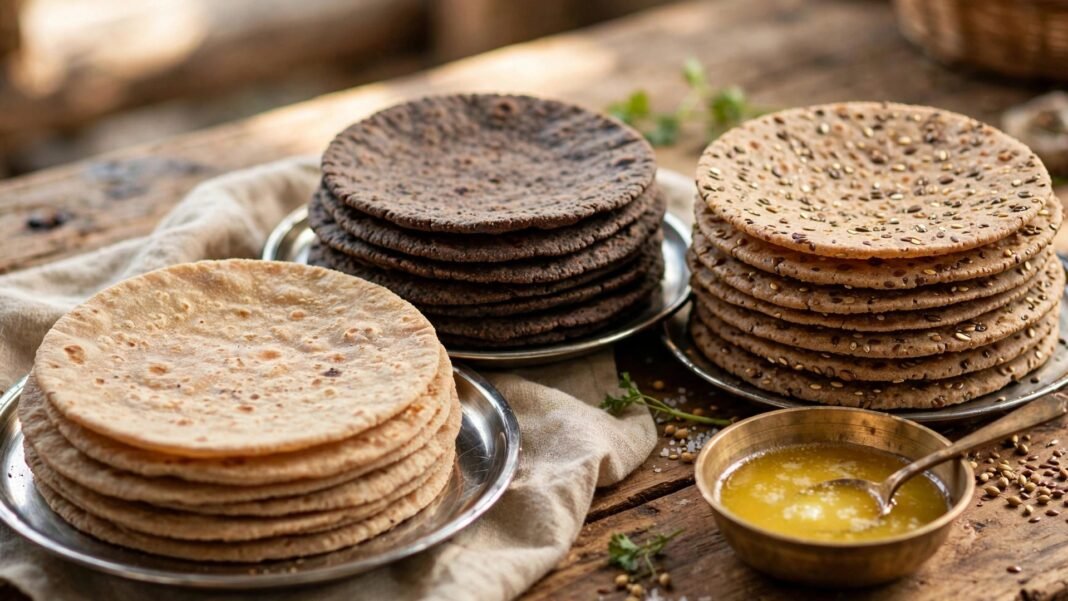
How many calories in 1 roti? It is one of the most searched nutrition questions in India, and the honest answer is: it depends on the size, the flour, and what you put on it. A small dry phulka can be as light as 70 calories, while a large ghee-laden roti can cross 150. Most online answers give you a single number without explaining the variables, which is why two people can both eat “3 rotis” and consume wildly different calories. This guide breaks down the calories in 1 roti by type: whole wheat, multigrain, bajra, jowar, and with ghee, so you can count accurately.
How Many Calories in 1 Roti: The Quick Answer
A medium whole wheat roti (about 35 to 40 g, roughly 6 inches across), cooked with little or no oil, contains approximately 100 to 112 calories, with about 3 to 4 g of protein, 20 to 22 g of carbohydrates, 2.5 to 3.5 g of fibre, and 1 to 1.5 g of fat. A small roti (30 g) drops to about 80 to 85 calories, and a large roti (50 g) climbs to 140 to 150. A phulka puffed directly on the flame with no oil is typically 70 to 90 calories because it uses less dough.
These numbers assume plain preparation. Every teaspoon of ghee or oil brushed on top adds about 45 calories, and a tablespoon adds about 120. That single variable explains most of the confusion around roti calories: a “120-calorie roti” becomes a 165-calorie roti the moment ghee is smeared on it.
Calories by Roti Type
- Whole wheat roti (medium, 40 g): 100 to 112 calories. The standard Indian roti. Good fibre from the bran, moderate protein, and the baseline against which everything else is compared.
- Multigrain roti (medium, 40 g): 104 to 115 calories. Made from a mix of wheat, jowar, bajra, ragi, and besan. Slightly more protein and fibre than plain wheat, with a lower glycemic impact. One of the best everyday choices.
- Bajra roti (medium, 40 g): 91 to 127 calories. Pearl millet is gluten-free, rich in iron and magnesium, and high in fibre. Plain bajra roti without ghee sits around 90 to 100 calories; the higher figures you see online usually include ghee used in traditional preparation.
- Jowar roti (medium, 40 g): 100 to 115 calories. Sorghum is another gluten-free millet with good fibre. Similar calories to wheat but digests slower, keeping you full longer.
- Ragi roti (medium, 40 g): 93 to 115 calories. Finger millet is exceptionally rich in calcium. Slightly lower protein than wheat but excellent for bone health.
- Besan roti / missi roti (medium, 40 g): 120 to 140 calories. Chickpea flour boosts protein to 6 to 8 g per roti, the highest among common rotis. The extra calories come with extra nutrition.
- Oats roti (medium, 40 g): 120 to 136 calories. Higher fibre from beta-glucan, good for cholesterol and fullness.
- Naan (restaurant, 1 piece): 200 to 260 calories. Made from refined flour with oil or butter, naan is in a different league. One naan can equal two rotis.
- Tandoori roti (restaurant): 130 to 170 calories. Larger and thicker than home rotis, often brushed with butter.
- Aloo paratha (1, medium, with oil): 170 to 250 calories. The potato filling plus shallow-frying oil makes this a meal in itself, not a roti equivalent.
The Ghee Effect: How Toppings Change the Count
Ghee is the single biggest variable in roti calories, and it deserves its own math. One teaspoon of ghee contains about 45 calories and 5 g of fat. Most Indian homes brush roughly half to one teaspoon per roti. So your “100-calorie roti” realistically becomes 125 to 145 calories with ghee. Across 4 rotis, that is 100 to 180 hidden calories, the equivalent of an extra roti you never counted.
This does not mean ghee is the enemy. Used in measured amounts (1 to 2 teaspoons a day total), ghee adds flavour, helps absorb fat-soluble vitamins, and increases satiety. The problem is only the free pour. If you are counting calories for weight loss, either skip the ghee on rotis or measure it with a spoon for a week until your eye learns the portion. Butter adds the same calories as ghee, and oil adds roughly 40 calories per teaspoon.
How to Fit Roti Into a Weight Loss Diet
Roti is one of the easiest foods to portion-control, which is a genuine advantage over rice. Decide your number before the meal: 2 small rotis for weight loss is a sensible default for most adults, paired with dal and lots of sabzi. Eat them with protein-rich accompaniments (see our protein-rich vegetarian foods guide for ideas) so the meal keeps you full for hours. Prefer phulkas or tawa rotis over parathas, and save ghee for one roti instead of all of them.
Why Online Roti Calorie Counts Disagree So Much
If you have ever googled roti calories and found numbers ranging from 70 to 150 for the “same” roti, you are not imagining things. The variation comes from five real differences. First, dough weight: a 30 g roti and a 50 g roti differ by 60 percent in calories before anything else changes, and home rotis vary enormously in size. Second, flour type: millet and besan rotis have different calorie densities than wheat. Third, added fat in the dough itself: some families knead a spoon of oil into the atta, adding 40 to 80 hidden calories per roti. Fourth, cooking fat: a dry phulka versus a roti roasted
with oil differ by 40 to 90 calories. Fifth, toppings: ghee, butter, or malai brushed on top.
This is why the most useful approach is not memorising one number but weighing your own roti once. Make your usual roti, weigh the dough ball on a kitchen scale, and calculate from there: whole wheat flour has roughly 340 calories per 100 g of flour, so a 30 g dough ball (about 20 g flour plus water) works out to around 70 calories of flour plus whatever fat you add. Do this once and you will count accurately forever. Kitchen scales cost 300 to 500 rupees online and are the single best investment for anyone serious about weight management.
It is also worth noting that restaurant rotis are a different product from home rotis. Tandoori rotis and naans are bigger, made from refined flour, and routinely brushed with butter. When eating out, assume each roti or naan carries 50 to 100 calories more than your home version, and plan the rest of the meal accordingly.
If you are comparing staples, read our roti vs rice for weight loss breakdown, and if breakfast is your battleground, our oats vs poha comparison will help. For complete planning, the 7-day vegetarian weight loss diet plan puts roti portions into a full daily menu.
For detailed calorie tables, see Clearcals’ roti calories and nutrition guide and the Times of India analysis of how nutritious different rotis are.
Sources: Clearcals nutrition desk, Tarla Dalal nutrition data, The Times of India nutrition desk.
Disclaimer: This article is for general informational purposes only and is not medical advice. Please consult a qualified healthcare professional before making changes to your diet, exercise, or treatment.
Frequently Asked Questions
Which roti has the lowest calories?
A small dry phulka at 70 to 90 calories. Among flours, plain bajra and jowar rotis without ghee are among the lightest at roughly 90 to 115 calories.
How many calories does ghee add to a roti?
One teaspoon adds about 45 calories and one tablespoon adds about 120. Across four rotis, ghee can contribute 100 to 180 hidden calories.
Are restaurant naans much higher in calories than home rotis?
Yes. One restaurant naan at 200 to 260 calories can equal two home rotis, thanks to refined flour, larger size, and butter brushing.
How many rotis should I eat per meal for weight loss?
Two small rotis with dal and plenty of sabzi is a sensible default for most adults. Adjust the number to fit your total daily calorie target.