
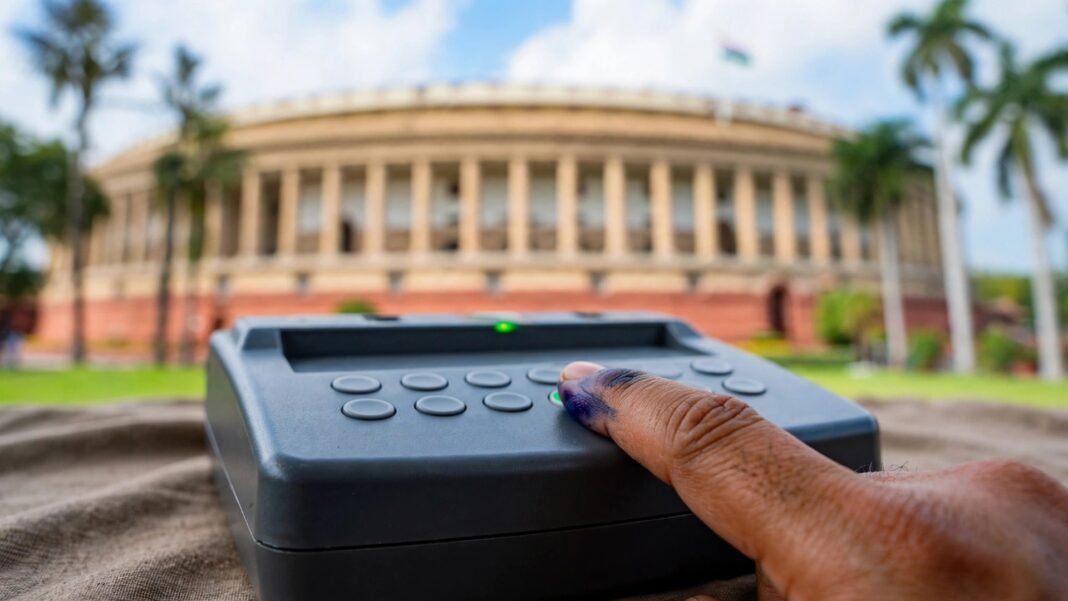
The One Nation One Election bill, explained simply, is a proposal to hold elections to the Lok Sabha and all state assemblies at the same time, on a single fixed schedule, instead of the current system where some state or the other goes to polls almost every year. Two bills to enable this, the Constitution (129th Amendment) Bill, 2024 and the Union Territories Laws (Amendment) Bill, 2024, were introduced in the Lok Sabha on 17 December 2024 and sent to a Joint Parliamentary Committee for detailed examination. Supporters call it a reform that will save money and unblock governance; critics warn it threatens federalism and could concentrate power. Here is how it is supposed to work and why it worries its opponents.
One Nation One Election Bill Explained: How It Would Work
India actually had simultaneous elections from 1951-52 until 1967. The cycle broke when several state assemblies were dissolved early, in 1968-69, and then the Lok Sabha itself was dissolved a year early in 1970, after which central and state polls drifted onto separate calendars. The current push began with a High-Level Committee on Simultaneous Elections headed by former President Ram Nath Kovind, constituted in September 2023, which submitted its report on 14 March 2024. The Union Cabinet accepted its recommendations in September 2024, and the two bills followed in December.
The mechanism proposed is roughly this. After a general election, the President would notify an “appointed date” marking the start of the simultaneous cycle. State assemblies elected after that date would servetruncated terms
so that all of them, along with the Lok Sabha, face the voters together in the next cycle, targeted after the 2029 general election. If a Lok Sabha or assembly is dissolved early or falls mid-term, fresh elections would be held only for the remainder of the term, not a full five years, so the synchronised calendar is not disturbed. Elections to municipalities and panchayats would be held within 100 days of the simultaneous polls. Because the plan amends the Constitution, it needs a special majority, two-thirds of members present and voting, in Parliament, and some provisions would additionally need ratification by at least half the states.
Why Supporters Want It
The government’s case rests on four arguments. First, cost: holding one mega-election instead of several rounds a year would save thousands of crores in expenditure on security, polling staff, EVMs and logistics. Second, governance: with elections happening somewhere almost every year, the Model Code of Conduct repeatedly freezes policy announcements and new schemes; a single cycle would free governments to govern for longer uninterrupted stretches. Third, administrative strain: teachers, paramilitary forces and officials are pulled into election duty repeatedly, disrupting schools and normal administration. Fourth, voter fatigue and turnout: supporters argue that fewer, bigger elections could improve participation and let voters judge governments on performance rather than constant campaign noise.
Why Critics Worry: The Objections
The opposition’s concerns are constitutional and practical. The foremost is federalism: critics argue that forcing all states onto a single national timetable subordinates state politics to the national cycle and could let a dominant national narrative drown out regional issues, disadvantaging regional parties. There are also basic-structure concerns, with some arguing that the fixed, synchronised tenures alter the Constitution’s scheme in ways courts may have to test.
The trickiest practical questions concern premature dissolution. If a state government loses its majority two years into a five-year term, the bill provides for elections only for the remaining three years, which critics say creates unstable, lame-duck governments nobody wants to form. If President’s Rule is imposed and an assembly is dissolved early for political reasons, the synchronised system could, in theory, be misused to cut short opposition-ruled states, a fear rooted in the Emergency-era history of Article 356. Logistical questions are also serious: simultaneous polls would need roughly double the current stock of EVMs and VVPATs, massive central force deployment, and storage on an unprecedented scale.
Legal experts consulted by the Joint Parliamentary Committee have split on these questions. Former Chief Justice D. Y. Chandrachud told the committee that simultaneous elections do not by themselves violate the Constitution’s basic structure, but warned that the Election Commission’s proposed powers need guardrails, that postponements should be for fixed limited periods only, and that the bill is silent on situations such as a National Emergency extending tenures or an assembly collapsing months before its term ends. In July 2026, the committee indicated that the framework conforms to the Constitution, while in October 2026 a controversy erupted over the committee’s proposed interaction with sitting Supreme Court judges, with the opposition objecting on separation-of-powers grounds and the visit being shelved.
Current Status and What It Means Now
As of late 2026, the two bills remain with the 41-member Joint Parliamentary Committee chaired by BJP MP P. P. Chaudhary, whose tenure was extended to the Monsoon Session of 2026. The committee has held over a dozen sittings across the country and consulted former chief justices, constitutional experts and stakeholders. Even if the committee reports favourably, the government would still need to muster a two-thirds majority in both Houses and, for some provisions, ratification by half the states, a steep political climb that makes the proposal’s future uncertain.
For voters, the debate is about what kind of democracy India wants: one optimised for administrative efficiency and cost, or one that preserves the current rhythm where state elections give regional voices their own stage. The proposal sits alongside other structural debates of this decade, from the caste census to delimitation, each of which will reshape how Indians are counted and represented. Whether or not simultaneous elections ever happen, the argument has already forced a serious national conversation about the price of perpetual campaigning.
What Happens Next: The Political Math
One Nation One Election: Key Takeaways
The one nation one election proposal is the most ambitious electoral reform attempted in India since 1951. Whether one nation one election succeeds depends on building consensus across parties and states, not just parliamentary arithmetic. Supporters of one nation one election argue it will save money and improve governance, while critics of one nation one election fear it threatens federalism. The one nation one election debate is ultimately about what kind of democracy India wants. For now, the one nation one election bills remain with the Joint Parliamentary Committee, and their fate will shape Indian politics for decades.
The proposal’s fate now rests on parliamentary arithmetic and state politics. A constitutional amendment needs two-thirds of members present and voting in each House, and the government does not currently command that majority on its own, which means it needs opposition support it does not have. Several opposition parties and regional satraps have declared their opposition, framing the bill as an attack on federalism, while some parties remain non-committal. The provisions requiring ratification by half the state legislatures add another veto layer, since opposition-ruled states are unlikely to cooperate.
Realistically, analysts see three scenarios: the bill stalls in committee or in Parliament and the idea returns to the back burner; a diluted version passes, perhaps starting with simultaneous Lok Sabha and assembly polls while leaving local bodies out; or a future government with a bigger majority revives it wholesale. The JPC’s report, expected after the Monsoon Session of 2026, will be the next milestone. Until then, the proposal functions as much as a statement of intent as a legislative project, signalling the government’s preference for fewer, synchronised electoral cycles while the political numbers catch up.
How Other Countries Do It
Simultaneous elections are not an Indian invention. South Africa holds national and provincial elections together every five years; Sweden elects its parliament, county councils and municipal councils on the same day; Indonesia held the world’s largest single-day election in 2019, combining presidential, parliamentary and local polls. Supporters of the Indian proposal cite these examples to argue that synchronised cycles are workable in large democracies.
Critics respond that the comparisons are imperfect: South Africa’s provinces and Sweden’s municipalities have far less autonomous political life than Indian states, and Indonesia’s 2019 exercise was marred by logistical strain and hundreds of polling-staff deaths from exhaustion. India’s scale, nearly a billion voters, federal structure with powerful regional parties, and history of mid-term collapses make it a harder case than any of these. The international experience suggests simultaneous polls are possible but demand extraordinary administrative preparation, which is why the Election Commission’s readiness is central to the Indian debate.
Sources: The Hindu: Why separation of powers is an issue in the ONOE panel’s proposed SC visit; Bar and Bench: Former CJI Chandrachud’s views before the JPC.
Frequently Asked Questions
How would simultaneous elections work?
After a general election, an appointed date would start the cycle; later-elected assemblies would serve truncated terms to sync up, and mid-term collapses would trigger polls only for the remainder of the term.
Why do supporters want One Nation One Election?
They argue it would save thousands of crores, reduce repeated Model Code of Conduct disruptions to governance, ease the burden on security forces and officials, and cut voter fatigue.
Why do critics oppose simultaneous elections?
Critics warn it threatens federalism, could drown out regional issues, creates problems when governments fall mid-term, and would need huge EVM and security logistics.
What is the current status of the bill?
The bills are with a 41-member Joint Parliamentary Committee chaired by P. P. Chaudhary, whose tenure was extended to the Monsoon Session of 2026. Passage needs a two-thirds majority.