
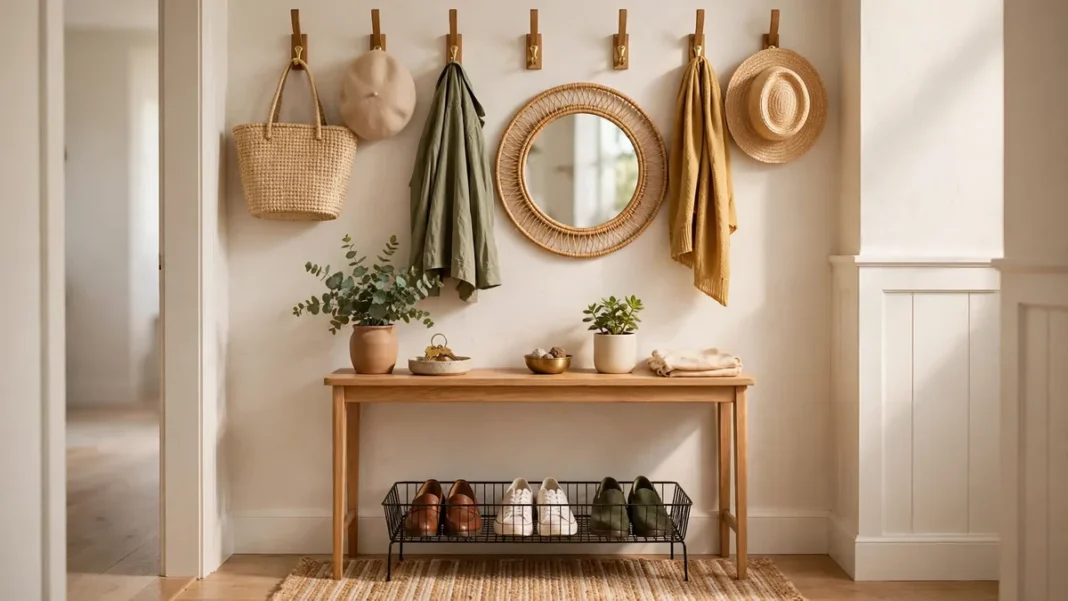
An entryway setup under $100 is not about buying cheap furniture. It is about giving every item that crosses your front door a home, so shoes, keys, coats and mail stop piling up where you walk. Most entryways fail for the same reason: they were never planned, so everything lands on the nearest surface. A hundred dollars, spent in the right order, fixes that for good.
The plan below works for rented flats, studios and houses with no foyer at all. It uses no drilling where drilling is banned, and every piece can move with you to the next place. Start with measurements, not shopping, and the budget almost takes care of itself.
Entryway Setup Under $100: The Plan
1. Measure First, Buy Second
Measure the width of your entry, the swing of the front door, and the depth you can spare without blocking the path. Keep 30 to 36 inches of clear passage, and choose a console no deeper than 10 to 14 inches if space is tight. A beautiful piece that blocks the walkway is not a bargain at any price, and it is the most common entryway mistake. Tape the footprint on the floor for a day and walk through it with a bag in hand before you spend anything.
2. The $100 Budget Breakdown
Here is a sample basket that stays under $100 using typical prices for budget pieces. Mix and match to fit your space rather than buying all of it.
- Adhesive hook set, 6-pack: around $8 — coats and bags, no tools needed
- Over-the-door hook rack: around $12 — damage-free hanging when wall space is short
- Slim two-tier shoe rack: around $15 — keeps shoes visible but contained
- Console tray or key dish: around $9 — keys, sunglasses and mail stop scattering
- Entryway mat: around $13 — catches dirt before it reaches the rest of the house
- Small basket for scarves and gloves: around $10 — one container beats a loose pile
- Round wall mirror, adhesive or leaning: around $20 to $25 — bounces light and makes the space feel larger
That basket totals roughly $87 to $92, leaving a few dollars for spare adhesive strips or a small plant. If you already own a mirror or a basket, skip those and put the savings toward a better shoe rack, which is the piece that takes the most daily abuse.
3. Hooks at the Right Height
Hooks fail when they are placed where nobody reaches them. Mount the main row at 60 to 66 inches for adult coats, and add a lower row at about 40 inches if kids use the entry. For renters, adhesive hooks rated for the load are the simplest option, and the same damage-free logic from our home guides applies: check the weight rating and stay under it. One hook per person, plus one spare, is enough — a wall of empty hooks looks worse than no hooks at all.
4. The One-Touch Rule
Every item should be put away in one motion when you walk in. Keys go in the tray, shoes go on the rack, coats go on a hook, mail goes in the basket. The moment an item needs two steps — carried to another room, stacked for later — it becomes clutter. This rule is also why a small entry works better than a big one: fewer surfaces mean fewer places for things to be abandoned. For the rest of the house on the same budget logic, see our guide to budget home decor items that look expensive. For adhesive hook weight limits, check the official Command strips product page from 3M.
5. Small Entryway Layout Rules
If you have no floor space at all, go vertical: adhesive hooks, an over-the-door rack and a wall key holder use zero floor area and cost under $30 combined. If you have a narrow wall, a slim console with a tray on top and baskets underneath is the single most useful piece. If your entry opens straight into the living room, a rug and a narrow console visually mark the boundary without building anything. In every case, declutter before buying: removing unused shoes and old bags often frees more space than a new organizer.
Frequently Asked Questions
What if my front door opens into the entryway?
Measure the door swing first and keep that arc completely clear. Use the wall beside the door, not the wall behind it, and choose a console no deeper than 10 to 14 inches.
How do I stop shoes piling up by the door?
Give shoes one defined home — a slim two-tier rack or a tray — and cap the number of pairs per person. Shoes without a home always become a pile.
Is $100 enough for a family entryway?
For the basics, yes: hooks, a shoe rack, a tray and a mat cover most families. Add one hook and one basket per person rather than buying bigger furniture.
Do adhesive hooks work on textured walls?
Not reliably. Adhesive hooks need smooth surfaces like painted walls, wood, metal, tile or glass. On textured walls, use over-the-door racks or freestanding furniture instead.