
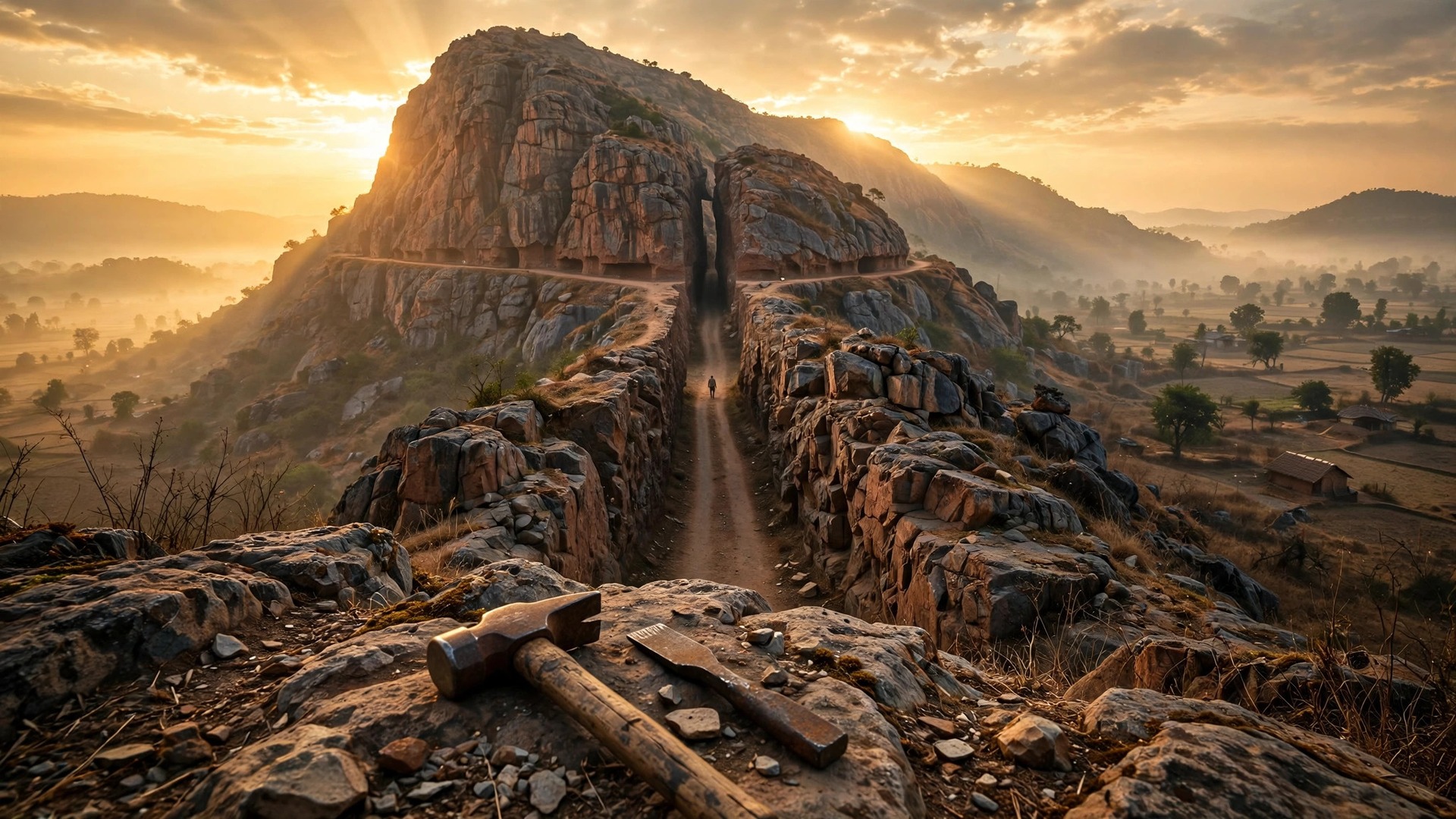

What would you do if grief knocked on your door? Most of us would mourn, and in time, move on. But in a small village in Bihar, a poor labourer picked up a hammer and a chisel, walked up to a mountain — and refused to stop for 22 years. This is the Dashrath Manjhi story, the true tale of India’s “Mountain Man,” and it will change the way you look at your own problems.
The Day Everything Changed
Dashrath Manjhi was born on 14 January 1934 in Gehlaur, a poor village near Gaya in Bihar, into the Musahar community — among the most disadvantaged in the region. He worked as a daily-wage labourer, married Falguni Devi, and lived the hard, simple life of rural India in those years.
Gehlaur had one cruel problem: a massive rocky ridge stood between the village and the nearest town, Wazirganj, where the only doctor was. To reach help, villagers had to walk all the way around the mountain — a journey of about 55 kilometres.
Then tragedy struck. Falguni Devi was injured while crossing the rocky terrain — according to most accounts, she fell while bringing food and water to her husband — and she could not be taken to a hospital in time. The mountain that had always stood in the village’s way had now taken his wife. Their baby daughter survived; his wife did not.
A Vow Carved in Stone
Grief breaks most people. It forged Manjhi. He made a vow that sounded insane to everyone who heard it: he would carve a road straight through the mountain, so that no one in his village would ever again lose a loved one for want of a hospital.
With nothing but a hammer, a chisel, and later a crowbar, he began chipping at solid rock. Alone. Day after day, year after year. Villagers laughed at him. They called him a lunatic — a poor man wasting his life against stone. Manjhi did not argue. He simply kept striking.
He laboured in the fields during the day to feed his family, and attacked the mountain in the hours he could steal. For 22 years — roughly from 1960 to 1982 — the rhythm never changed: strike, chip, clear, repeat.
The Mountain Surrenders
Slowly, impossibly, a cleft appeared in the rock. Manjhi widened it. And kept widening it. When he finally stopped, he had carved a path 110 metres long, 9.1 metres wide, and 7.7 metres deep — straight through the ridge.
The result was staggering: the distance between the Atri and Wazirganj blocks of Gaya district fell from 55 kilometres to just 15. What once took a full day’s treacherous journey could now be walked in a fraction of the time. Children reached schools. The sick reached doctors. The mockery turned to reverence, and the “lunatic” became a folk hero — the Mountain Man of India.
Recognition came late, as it often does. Manjhi travelled to New Delhi seeking acknowledgement for his work, and the Bihar government honoured him. When he died of gallbladder cancer on 17 August 2007 at the age of 73, the state gave him a full state funeral. In 2016, India Post issued a postage stamp in his honour. His life even inspired the acclaimed film Manjhi – The Mountain Man.
What the Dashrath Manjhi Story Teaches Us
Manjhi’s story is not really about a mountain. It is about what happens when pain finds a purpose. He did not have money, education, machines, or support. He had a hammer, a chisel, and a reason that would not let him quit.
Three lessons live in those 22 years. First, start where you are with what you have. Manjhi never waited for the “right time” or better tools — he started chipping. Second, ignore the laughter. Every big dream sounds crazy until it is done; the villagers who mocked him eventually walked on his road. Third, let your “why” carry you through the “how.” Twenty-two years of lonely labour is impossible without a reason bigger than comfort — his was love, and a promise that no one else should suffer as he did.
The next time a problem in your life looks like a mountain, remember Gehlaur. One man, one hammer, one chisel — and a mountain moved. Your mountain is smaller than you think. Pick up your hammer.
Frequently Asked Questions
Why did Dashrath Manjhi break the mountain?
His wife, Falguni Devi, died after an accident on the rocky terrain because she could not be taken to a hospital in time — the mountain blocked the short route. Manjhi vowed no one else in his village would suffer the same fate, and began carving a direct path through the ridge.
How long did it take Manjhi to carve the road?
About 22 years, roughly from 1960 to 1982. He worked mostly alone, labouring in fields by day to support his family and chipping at the rock in his remaining hours. Villagers initially mocked him as crazy before his perseverance won their respect.
How much did the road reduce the travel distance?
The carved path — 110 metres long, 9.1 metres wide and 7.7 metres deep — cut the distance between the Atri and Wazirganj blocks of Gaya district from about 55 kilometres to roughly 15 kilometres, giving villagers far easier access to doctors, schools and markets.
Was Dashrath Manjhi honoured for his work?
Yes, though recognition came late. The Bihar government honoured him, he was given a state funeral when he died of gallbladder cancer in 2007, India Post issued a commemorative stamp in 2016, and his life inspired the film “Manjhi – The Mountain Man.”