


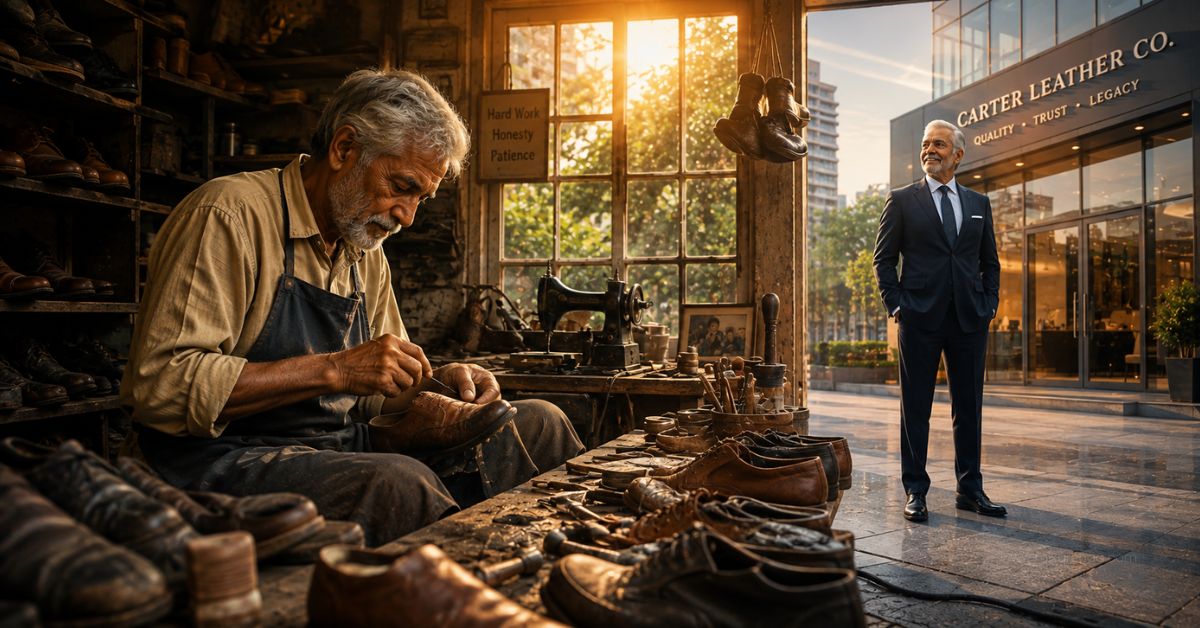
“Sometimes, the person who has the least money can teach you the most about wealth.”
The first time I saw the old shoemaker, I was angry.
Not at him.
At life.
I was twenty-seven years old, unemployed, buried in debt, and convinced that everyone else was moving forward while I stood still.
My friends were buying cars.
Some were getting married.
Others were starting businesses.
And I was sitting on a broken wooden bench outside a tiny shoe-repair shop, counting the last few coins in my wallet.
I had less than enough money for dinner.
That’s when the old man looked at me and said,
“You look like someone who has lost something.”
I laughed bitterly.
“Everything.”
He smiled.
“No.”
“You’ve only lost your direction.”
I didn’t understand what he meant.
Not then.
But three years later, those words would become the reason my life changed completely.
The Little Shop at the End of the Street
His name was Samuel.
At least, that’s what the small handwritten sign outside his shop said:
SAMUEL’S SHOE REPAIR
The shop was barely large enough for two people.
Old leather shoes hung from wooden hooks.
A small fan turned slowly in the corner.
The walls were covered with faded photographs.
There was an old radio on the counter and a wooden toolbox that looked older than I was.
I had walked into the shop because one of my shoes had a broken sole.
Samuel examined it carefully.
“Ten dollars.”
I checked my wallet.
“I only have seven.”
He looked at me.
Then he repaired the shoe anyway.
“Pay me the rest when you can.”
I was surprised.
“Why?”
He shrugged.
“Because sometimes people need shoes more than I need money.”
I thanked him and walked away.
But something about that sentence stayed with me.
I Came Back the Next Day
The following morning, I returned.
Not because my shoe was broken.
I wanted to ask him something.
“How long have you owned this shop?”
Samuel smiled.
“Forty-three years.”
“Forty-three?”
“Yes.”
I looked around.
“You must have made a lot of money.”
He laughed.
“Money isn’t the only thing you can make.”
I frowned.
“What does that mean?”
He pointed toward the shoes hanging around us.
“People bring me broken things.”
“I return them useful.”
He paused.
“That’s a good business.”
I smiled.
“That’s it?”
“No.”
He leaned forward.
“The real business is learning why people keep coming back.”
His Strange Rule
Samuel had one unusual rule.
He never threw away an old pair of shoes until he had tried everything possible to repair them.
I once watched him spend nearly an hour repairing a pair of shoes that looked completely ruined.
“Why waste so much time?” I asked.
“You could buy a new pair for less.”
Samuel continued stitching.
“That’s exactly why people waste things.”
“Because they don’t know how to see value.”
He finally looked at me.
“Most people don’t throw things away because they’re worthless.”
“They throw them away because they’re inconvenient.”
That sentence hit me harder than I expected.
Because I realized…
I had been doing the same thing with my own life.
One failure…
I wanted to quit.
One rejection…
I wanted to give up.
One bad month…
I thought my future was ruined.
Maybe I wasn’t broken.
Maybe I was simply unfinished.
The Notebook
A few weeks later, Samuel gave me an old notebook.
The cover was torn.
The pages were yellow.
“What’s this?” I asked.
“My life’s notes.”
I opened it.
There were hundreds of handwritten observations.
Not about shoes.
About people.
One page said:
“People pay for what they value, not what you think is valuable.”
Another said:
“A good business solves a problem. A great business understands a person.”
Another:
“Never compete only on price. Become impossible to replace.”
I stared at him.
“You’ve written all this?”
“For forty-three years.”
“Why haven’t you written a book?”
Samuel laughed.
“Who would read a book written by a shoemaker?”
I didn’t answer.
Because I would.
The Idea
One afternoon, I told Samuel about an idea I’d been thinking about.
An online marketplace for repairing and restoring old shoes.
People could send photographs of damaged shoes.
We would estimate the repair cost.
Customers could then send their shoes to trusted repair specialists.
Samuel listened carefully.
Then he asked one question.
“Why would someone use your service?”
“Because it’s convenient.”
He shook his head.
“Try again.”
“Because it saves money.”
He shook his head again.
“Try again.”
I thought for a moment.
“Because they don’t want to throw away something they love.”
Samuel smiled.
“Now you understand.”
That became the foundation of my business.
The First Failure
I built the website.
I spent almost all my savings.
I created social media pages.
I ran advertisements.
And…
Nothing happened.
Five customers.
Then three.
Then zero.
After four months, I was ready to shut everything down.
I went back to Samuel.
“I failed.”
He was repairing a brown leather boot.
“How many customers did you have?”
“Eight.”
“And how many came back?”
“Six.”
He smiled.
“Then you didn’t fail.”
“You found six people who trust you.”
I didn’t understand.
He continued.
“Eight customers are not a business.”
“But six returning customers might become one.”
He was right.
I stopped chasing thousands of customers.
Instead, I focused on the few I already had.
I asked them questions.
What did they like?
What frustrated them?
What would make the service better?
I listened.
Then I improved.
The First Breakthrough
Six months later, something unexpected happened.
One of our customers posted a video online showing the restoration of his grandfather’s old leather shoes.
The video went viral.
Then another customer shared her restored wedding shoes.
Then another.
People started sending us shoes that had sentimental value.
A father’s boots.
A grandfather’s shoes.
A wedding pair.
A first-job pair.
Shoes people couldn’t replace because the memories attached to them were priceless.
Our business grew.
Slowly.
Then quickly.
Within two years, we had repair partners in multiple cities.
Investors contacted us.
Customers started recommending us.
And eventually…
The company became profitable.
Very profitable.
I Bought Samuel a New Shop
Three years after I first met him, I returned to Samuel’s shop.
But this time, I brought something with me.
A set of keys.
He looked confused.
“What are these?”
I smiled.
“Your new shop.”
He stared at me.
“What?”
I handed him the keys.
A beautiful new workshop stood across the street.
Modern equipment.
Better lighting.
More space.
But I had kept one thing exactly the same.
A small wooden sign:
SAMUEL’S SHOE REPAIR
His eyes filled with tears.
“You didn’t have to do this.”
“I know.”
“Then why?”
I smiled.
“Because you once repaired a seven-dollar shoe for someone who couldn’t afford it.”
He looked at me quietly.
“And because you taught me how to repair my life.”
His Final Secret
That evening, we sat outside the new shop.
I finally asked him the question that had been in my mind for years.
“Samuel, what was your secret?”
He smiled.
“I’ve already told you.”
“No. Your real secret.”
He thought for a moment.
Then he said:
“I never tried to become rich.”
I looked at him.
“Then what did you try to become?”
He pointed toward his old toolbox.
“Useful.”
I didn’t say anything.
He continued.
“When you become useful to enough people, money eventually finds you.”
“But when money becomes your only goal, you’ll spend your whole life chasing it.”
That was the day I understood something I had never learned in business school.
What Made Me Rich Wasn’t Money
Today, my company is worth millions.
I have a comfortable home.
I travel.
I employ hundreds of people.
But whenever someone asks me how I became successful, I don’t talk about the company.
I talk about an old shoemaker.
A man who spent forty-three years repairing things other people had decided were worthless.
He taught me that value isn’t always visible.
People can be like that too.
A person who failed ten times may have more experience than someone who succeeded once.
A person working a small job may have enormous dreams.
Someone struggling today may become a leader tomorrow.
And sometimes…
The person sitting quietly in the corner knows something everyone else has forgotten.
The Lesson
We live in a world obsessed with speed.
We want instant success.
Instant money.
Instant recognition.
But some of the most valuable things in life take time.
A tree needs years before it provides shade.
A business needs years before it earns trust.
A skill needs years before it becomes mastery.
And a person needs difficult seasons before they discover their strength.
So don’t be too quick to throw something away.
Not a dream.
Not an opportunity.
And certainly not yourself.
Maybe you’re not failing.
Maybe you’re being repaired.
The Most Important Thing Samuel Taught Me
“Don’t ask, ‘How can I become rich?’
Ask, ‘How can I become valuable?’
The rest often follows.”
Final Thought
If you’re currently struggling, remember the old shoemaker.
He spent his life repairing things people thought were finished.
And perhaps that’s what life is doing with you right now.
Maybe the setbacks aren’t destroying you.
Maybe they’re strengthening you.
Maybe the rejection isn’t the end.
Maybe it’s redirecting you.
Maybe the delay isn’t punishment.
Maybe you’re being prepared.
Don’t throw your story away just because the current chapter is difficult.
Some of the greatest transformations begin when everything appears broken.
Reflection Question
What if the part of your life you want to give up on is actually the part that is preparing you for your greatest success?
Share This Story
If this story gave you hope, share it with someone who is struggling right now.
They may not need another piece of advice.
They may simply need a reminder that their story isn’t over yet.